Showing posts with label ancient Persian Empire. Show all posts

Thursday, April 5, 2018

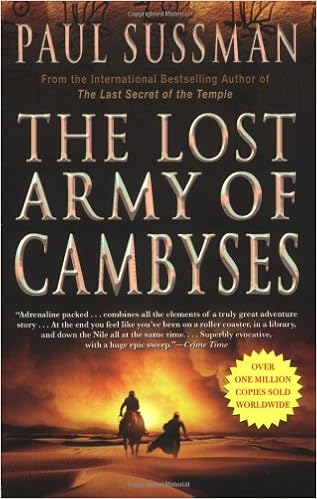
Review of Paul Sussman's "The Lost Army of Cambyses"

This is another historical detective set in modern day Egypt. When I started reading it I thought it was one of Will Adams' books. It had a very similar opening as in Adams' "The Alexander cipher" I reviewed few weeks back (in reality, it is likely Adams borrowed book "structure" from Sussman as latter's book was published at earlier date). 

Anyone who is into ancient history may know about the army of Persian King Cambyses lost in a desert storm following successful campaign to conquer the ancient Egypt in 6th century BC. 

When a fiction novel is about subject known to be inaccessible in reality one can immediately assume that by the time of its ending it should return to status quo. Indeed, this novel describes a rare, once in a life time archeological discovery of the lost Army and in the end the Army is lost again. 

The novel is a typical mystery detective story but the ending is actually very surprising and quite unexpecting.       

posted by David Usharaul


Sunday, March 19, 2017

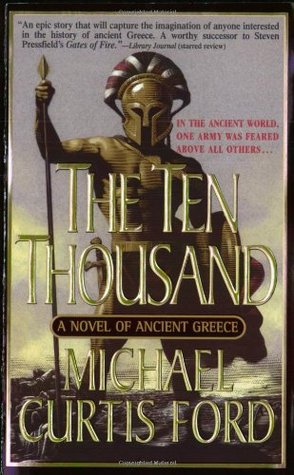
"The Ten Thousand" - a Greek military adventure in Persian Empire

This novel tells us about the first military adventure Greek mercenaries took that led them deep into Persian Empire between 401-399 B.C.  

First half of the book is quite good and fast paced, however later narrative slows down and becomes overloaded with descriptive information.

History tell us that Greek forces were hired by Cyrus who wanted to challenge his brother, then a Persian King. However, during the decisive battle near the ancient Babylon, Cyrus is killed and Greeks end up in the middle of the Persian Empire with their leaders betrayed and murdered. Thus begins famous retreat towards Black Sea under the leadership of Xenophon, who one studied with Socrates. Greeks are constantly tested in each region they pass by local hostile forces and Greek military training and tactics reveals its superiority. These experiences were later used by forced led by Alexander the Great.   

posted by David


Sunday, July 31, 2016

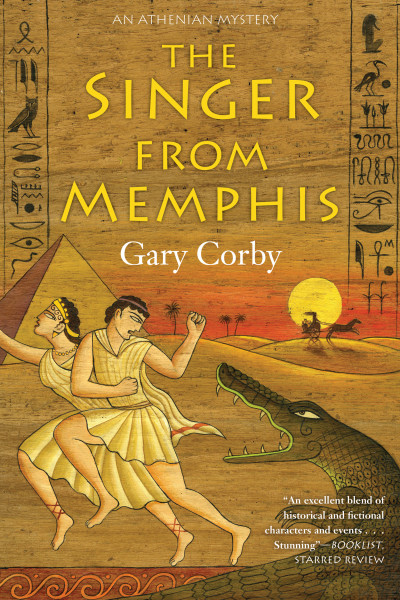
Review of "The Singer from Memphis" by Gary Corby

I already mentioned in my previous posts that I really liked an Athenian mystery series by Gary Corby. The author is able to present the complex historical events in simple language. No prior subject-matter knowledge is required to fully immersed and experience ancient Greece on the eve of birth of democracy.

This latest novel in this series is the best so far, in my view. What is unique about it compared to previous books is that it is very funny too. We follow the main characters into ancient Egypt. Along the way we encounter Persians from Achaemenid Empire who are about crush local rebellion, an assassin from Sparta and the head of Egypt's powerful Public service, the oldest system of bureaucracy in the world.

As a history goes the author got all major events right. Though, when it came to scenes about mummy preparations for afterlife, I found one major discrepancy between this novel and another famous novel called "The Egyptian" by Mika Waltari.     

In summary, I highly recommend to everyone to read these series.

posted by David  


Thursday, March 10, 2016

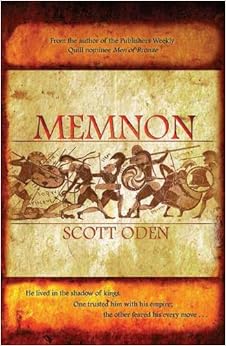
Review: "Memnon", a man who could have stopped Alexander the Great

I enjoy reading historical novels, especially those part of history that are less known. Almost everyone heard about Alexander the Great but very few people are familiar with his military adversaries during his conquest of Persian Empire.  

Specifically, one of the those military leaders from Persian side was a man called Memnon of Rhodes. He was a Greek subject of Persian Empire. We need to remember that lands we call Asia Minor, Palestine and Egypt were part of Persian Empire. Asia Minor was populated by ethnic Greeks for centuries by the time Alexander's Macedonian forces overrun the country. Not every Greek in Asia Minor believed that Macedonian had a right to invade their city states (that nominally acknowledged Persian  suzerainty). But it also explains part of Alexander's initial success in Asia Minor.

This fictional novel focus on Memnon's life. Novel is told [dictated] as a memoir by Barsine, Memnon's wife and member of Persian Royal family. We know little about Memnon except that he was a professional soldier and many believed he was the only person who could have stopped rapid advance of Macedonian Forces. However, Alexander's military fortune was on the rise. Memnon died soon after invasion from the wounds he received during the siege of the city of Halicarnassus. Most of the cities and Greek states in Asia Minor joined Alexander's side, thus protecting his supply chain and allowing him to focus on further invasion.

The novel itself is very easy read and beautifully written, though sometimes goes overboard with excessive descriptions. It does not have any unique plot structure, nor does it propose any novel interpretation of historically known facts. Though we know about Memnon from his role in fighting Alexander's Macedonians, the novel is mostly about Memnon's fictional life before the invasion. In general, many events described in book are fiction as acknowledged by the author himself. But many events are accurate too. So, in summary, it is a good read.

posted by David Usharauli


Monday, January 11, 2016

Review of Gore Vidal's epic novel "Creation"

I really like reading historical novels (fictions) especially those which re-interpret past events and provide different point of views. When I came across this book I was intrigued by its title image depicting a famous image of Achaemenid Persian Emperor Darius III (~332 b.c.) as known to us from Alexander the Great campaign.  

I was also intrigued by its title "Creation". Too grandiose. But surprisingly, in goodreads review it had more than 4 points that indicated good quality consensus. So I decided to read it.

It really starts extremely interesting. It is narrated in first person by Cyrus Spitama, a fictional "grandson" of Zoroaster, a founder of Zoroastrian religion in ancient Persia. As a child he is accepted in the Court of then Persian Emperor Darius I the Great and grows up alongside with Xerxes I, future Emperor. In general, novel covers the world period between ~500 b.c. and 450 b.c., so I have no idea why title image depicts Darius III who lived almost 150 years later and had nothing to do with any part of novel.

The novel itself follows Cyrus Spitama's upbringing and then travels as a Persian ambassador to India's gangetic kingdoms and China's warring states and later to ancient Athens. During his travel, Cyrus Spitama meets founders of Buddhism, Jainism and Confucianism. Novel is filled with discussions regarding various philosophies about religion, purpose of life and afterlife and their interpretations. 

Beyond religious concept, novel is interesting from historical point of view as well. It provides some detailed knowledge related to ancient customs practiced in ancient Persia, Greece, India and China. I really liked reading those details (of course, I can't be sure that all of the author's claims are historically accurate. For example, references to Aryan invasion is problematic since now we know that these events were a myth created by British to gain support of Indian aristocracy in 19th century). Besides this, very interesting were those parts of novel where Persian invasion of Greece were detailed. The novel mocks Greek version of events that transpired during those Persian invasions and provides alternative Persian view points.

In summary, I would recommend this book for a reading. If you can find it in local library, yes go ahead and read it. First half is really excellent. Second half is a little monotonous. Part of the novel about China is less well developed and feels more artificial.   

posted by David Usharauli