Showing posts with label 14th century. Show all posts

Sunday, April 21, 2019

Iain Pears' "The Dream of Scipio"- a review

This is a novel about how an individuals actions determine the course of history. It is set in the same geographical place but in three different historical periods, 5th century (fall of the western Roman empire), 14th century (black death) and 20th century (Nazi-occupied France) and tells the three separate but interconnected stories. 

These time periods are chosen deliberately to illustrate upheavals that people were facing at that time and how they deal with it. More precisely, it is a novel about 1500 years of anti-semitism in Western Europe and how some unscrupulous people exploited it for their own advantage. How to overcome hatred? It is not cool heads or intellectuals or wise people but love. If anything saves the world it is through love, love of nature, love of neighbors, love of women or man, love of everything.   

posted by David
   

Thursday, August 17, 2017

Review of "Plague Land" by S.D. Sykes

This novel is set in 1350, immediately following the Great plague, black death, that had devastated England. Within very short period, a prior social and economical structures that existed collapsed. Religious fanaticism and mysticism are pervasive.
 
Now new relationships are being established. Due to population decline, peasants who survived are gaining economical bargaining power with the land owners. 
 
It is in this environment that two teenage girls are brutally killed. Village people and their priest believe it is doing of a doghead, an evil creature with human body and head of a dog.
 
But Oswald de Lacy, Lord of Somershill, an young manor lord who just inherited this land from his father, believes a real person rather some evil creature killed both girls. His curiosity and persistence will lead to an unexpected and truly diabolical discovery. 
 
Highly recommended.
 
posted by David


Wednesday, November 16, 2016

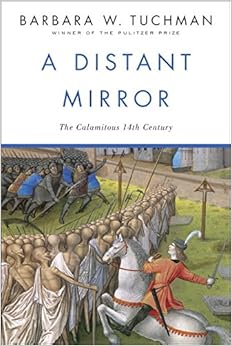
A Distant Mirror: The Calamitous 14th Century

This book an excellent overview of Western Europe during 14th century, though more accurately, it is a history of France as it existed in 14th century.

14th century in France is remembered mostly for 100 Years War fought between France and England and black death, a deadliest pandemic in human history that reduced total human population by 1/3. 

This book is mostly focused on relationships between nobles and Kings and portions are devoted to Church matters and peasant revolts.

It is interesting and easy to read, though I would say it is a little bit boring in the end. 

posted by David


Tuesday, August 25, 2015

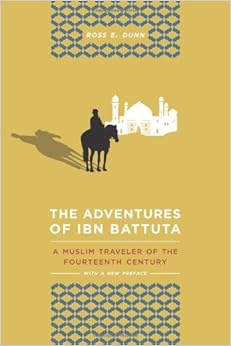
"The Adventures of Ibn Battuta" by Ross E. Dunn - Review

The "Mongol Peace" of 13th-14th centuries had enabled commerce on a global scale, for the first time since the fall of west Roman empire. Close to 100 years (around AD 1250-1350), travelers and merchants of whole Eurasia (both from west and east) could criss-cross the known world in relative peace. 

[Now this sounds exciting but if you ask me it would have been much better for a humankind if mongols would have never appeared on world stage in 13th century, to begin with. If there is a single event that negatively altered the whole history of humankind in the past 2000 years, it would be mongols].

In this book, Ross Dunn had analysed  travel accounts of the most famous [moroccan] explorer, Ibn Battuta. Born in early 14th century in modern day Morocco (then part of Marinid empire), Ibn Battuta left his native country when he was in his early twenties and spent traveling and residing in foreign countries for next 30 years. He was a modest scholar of Qu'ran. His travel itinerary covers whole of north Africa (Maghreb and Egypt), Saudi Arabia, modern day Turkey and Istanbul, Iran, Ukraine and south of Russia (Golden Horde), central Asia and Afghanistan, India and Sri Lanka, Maldives, south China and Mali Empire (African empire that were quite advanced with the regard to gender equality, even by 20th century standards). 

It appears that Ibn Battuta got married 6 times (5 of these marriages happened in Maldives). He was appointed as a chief judge in Delhi by shade of god Sultan Muhammad Tughluq.  

It is a twist of fate that almost every great empire Ibn Battuta visited during his travels collapsed within his life time or next 20 years (Mongol empire in Iran, Delhi Sultanate, Mongol empire in China, Mongol empire in Central Asia). 

It is remarkable that a single person could travel such length. In year 1347, on his way home to his native country, Ibn Battuta even survived black plague pandemia (1347), a global disease that put an end to global travel and precipitated collapse of mongol world empire.      

There is lots of books about Ibn Battuta, including his own account of his travels. However, for the beginners, it is advisable to choose the book that provides an analysis of his travels rather than to read Ibn Battuta's own accounts (which contains lots of inaccuracies). 

posted by David Usharauli