The "Mongol Peace" of 13th-14th centuries had enabled commerce on a global scale, for the first time since the fall of west Roman empire. Close to 100 years (around AD 1250-1350), travelers and merchants of whole Eurasia (both from west and east) could criss-cross the known world in relative peace.
[Now this sounds exciting but if you ask me it would have been much better for a humankind if mongols would have never appeared on world stage in 13th century, to begin with. If there is a single event that negatively altered the whole history of humankind in the past 2000 years, it would be mongols].
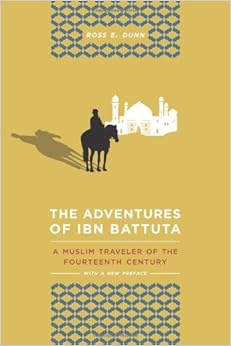
In this book, Ross Dunn had analysed travel accounts of the most famous [moroccan] explorer, Ibn Battuta. Born in early 14th century in modern day Morocco (then part of Marinid empire), Ibn Battuta left his native country when he was in his early twenties and spent traveling and residing in foreign countries for next 30 years. He was a modest scholar of Qu'ran. His travel itinerary covers whole of north Africa (Maghreb and Egypt), Saudi Arabia, modern day Turkey and Istanbul, Iran, Ukraine and south of Russia (Golden Horde), central Asia and Afghanistan, India and Sri Lanka, Maldives, south China and Mali Empire (African empire that were quite advanced with the regard to gender equality, even by 20th century standards).
It appears that Ibn Battuta got married 6 times (5 of these marriages happened in Maldives). He was appointed as a chief judge in Delhi by shade of god Sultan Muhammad Tughluq.
It is a twist of fate that almost every great empire Ibn Battuta visited during his travels collapsed within his life time or next 20 years (Mongol empire in Iran, Delhi Sultanate, Mongol empire in China, Mongol empire in Central Asia).
It is remarkable that a single person could travel such length. In year 1347, on his way home to his native country, Ibn Battuta even survived black plague pandemia (1347), a global disease that put an end to global travel and precipitated collapse of mongol world empire.
There is lots of books about Ibn Battuta, including his own account of his travels. However, for the beginners, it is advisable to choose the book that provides an analysis of his travels rather than to read Ibn Battuta's own accounts (which contains lots of inaccuracies).
posted by David Usharauli
Tweet
It appears that Ibn Battuta got married 6 times (5 of these marriages happened in Maldives). He was appointed as a chief judge in Delhi by shade of god Sultan Muhammad Tughluq.
It is a twist of fate that almost every great empire Ibn Battuta visited during his travels collapsed within his life time or next 20 years (Mongol empire in Iran, Delhi Sultanate, Mongol empire in China, Mongol empire in Central Asia).
It is remarkable that a single person could travel such length. In year 1347, on his way home to his native country, Ibn Battuta even survived black plague pandemia (1347), a global disease that put an end to global travel and precipitated collapse of mongol world empire.
There is lots of books about Ibn Battuta, including his own account of his travels. However, for the beginners, it is advisable to choose the book that provides an analysis of his travels rather than to read Ibn Battuta's own accounts (which contains lots of inaccuracies).
posted by David Usharauli