Showing posts with label Egypt. Show all posts

Thursday, August 2, 2018

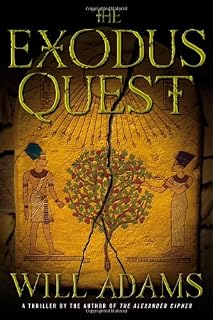
Will Adams' "The Exodus Quest" - from Akhenaten to Bible

This is a second book in archeologist Daniel Knox series. In this book he uncovers hidden treasures that supposed to show that Egyptian Pharaoh of 18th dynasty, Akhenaten (Ikhnaton) and his wife, Nefertiti, were actually original Adam and Eve of the Bible and that monotheistic religion of the Sun, Aten/Aton, introduced by Akhenaten in Egypt during his reign were adopted by his followers and after they were declared heretics and were forced to leave Egypt as in exodus became ancestors of modern day Jewish nation.

posted by David


Thursday, April 5, 2018

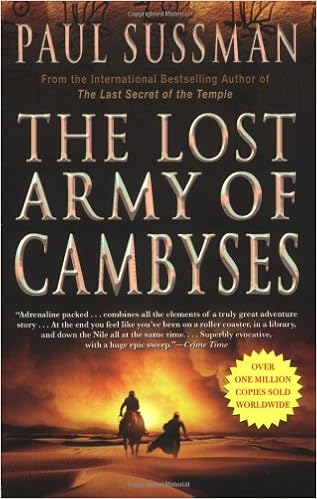
Review of Paul Sussman's "The Lost Army of Cambyses"

This is another historical detective set in modern day Egypt. When I started reading it I thought it was one of Will Adams' books. It had a very similar opening as in Adams' "The Alexander cipher" I reviewed few weeks back (in reality, it is likely Adams borrowed book "structure" from Sussman as latter's book was published at earlier date). 

Anyone who is into ancient history may know about the army of Persian King Cambyses lost in a desert storm following successful campaign to conquer the ancient Egypt in 6th century BC. 

When a fiction novel is about subject known to be inaccessible in reality one can immediately assume that by the time of its ending it should return to status quo. Indeed, this novel describes a rare, once in a life time archeological discovery of the lost Army and in the end the Army is lost again. 

The novel is a typical mystery detective story but the ending is actually very surprising and quite unexpecting.       

posted by David Usharaul


Wednesday, February 7, 2018

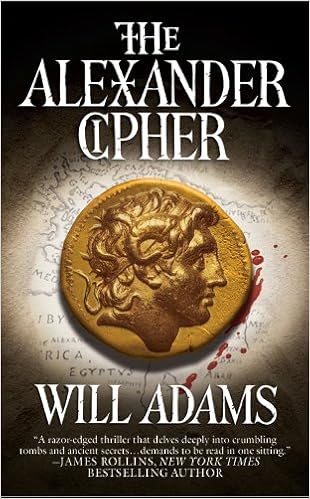
"The Alexander Cipher" - secret of the tomb of Alexander the Great

This novel is part archaeology part political thriller. The territory of ancient Macedonia covers modern-day Greece, Bulgaria, FYR of Macedonia and Albania. Wealthy Greek Macedonian Father and Son want to unify these separate territories into one country and resurrect old Macedonia. But to accomplish this goal they need something that make ordinary Macedonian people to rise up. 

They think the goal can be achieved if the tomb of the Alexander the Great is discovered. So they finance archaeological excavations in Egypt to find it.

Indeed, Daniel Knox, becomes involved in its discovery, by chance.

I liked this book. It has some some history, some realism, some fantasy. Egypt is shown with its powerful ministry of Antiquity, its wealthy, cruel but 'patriotic' magnates and ordinary Egyptians who try to do their best.       

posted by David Usharauli

Saturday, November 25, 2017

"I, The Sun" - A novel of the founder of Hittite Empire

Many historical novels in English literature are written about well-known historical people, kingdoms or episodes in history. However, such topics limit the author's ability to fully express his/her talent as a fiction writer. So, I decided to read historical book depicting less well known episodes in history.

Hittite Empire existed between 18th-12th century B.C. and occupied territory of today's Turkey and Syria. It was one of the 4 great Kingdoms of ancient world. Online book repositories such as Archive.org and Openlibrary.org have several freely available books about Hittites history. I especially liked reading C.W. Ceram's The Secret of the Hittites: The Discovery of an Ancient Empire. Remarkably, for 3000 years, until late 19th century, no one knew or imagined that in 2nd millennium B.C. in Asia minor there were people speaking and writing in Indo-European language who were the military superpower of the ancient world.

This novel, "I, the Sun", is a fictional account of the time when Hittites became Empire under its greatest King Suppiluliumas I (14th century B.C.). His rule coincides with the Egyptian Pharaohs Akhenaten (Heretic Pharaoh) and Tutankhamun and especially religious reformation conducted by the Egypt's Heretic King is widely discussed in the novel. In general, the novel pretty accurately follows historically verified evidence about King Suppiluliumas I reign. It is a good read for someone who wants to learn more about ancient world. 

posted by David Usharauli


Wednesday, April 27, 2016

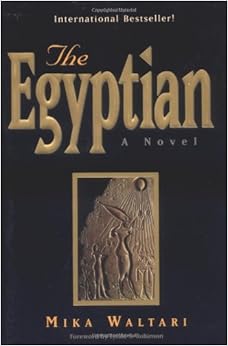
Akhenaton's Egypt: the world's first monotheistic and Marxist kingdom

This monumental historical novel about ancient Egypt depicts highly turbulent period at the end of 18th dynasty of Egypt (14th century BC).

The novel is a first-person narration by Sinuhe, an Egyptian physician to Pharaoh Akhenaton. 

The novel is conceptually divided in three parts. First part is mostly about Sinuhe's travel to Syria, Babylon, Mitanni, Hittite Kingdom and Crete.  

Second part tells the story of Pharaoh Akhenaton. It was this Pharaoh who introduced a monotheistic cult of Aton. When I was reading this part of the novel it was obvious to me that the author makes connection between Aton cult and its resemblance to early christian philosophy practiced in 1st century AD. 

Moreover, according to novel, Pharaoh Akhenaton even tried to transform Egyptian society into class-less society, very similar to what ordinarily are thought of Communist and Marxist societies.

As expected such radical ideas were not welcomed by Egyptian upper classes and in the end, Pharaoh Akhenaton was forced to commit suicide.

Third part of the novel tells the story following Pharaoh Akhenaton's death. It depicts brief reign of young Pharaoh Tutankhamon (whose original name was Tutankhaton) and the novel ends with Pharaoh Horemheb and the beginning of 19th dynasty (e.g. Ramses II).

This is quite long novel but though occasionally it is boring overall it is well written and interesting to read. 

posted by David Usharauli

Wednesday, September 16, 2015

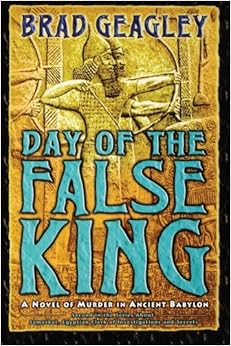
Review of Brad Geagley's historical novel "Day of the False King"

I really enjoyed reading this historical novel by Brad Geagley. It is so well written that when one reads it you don't feel that there is a single extra word in it. Everything is written with the purpose.

I also liked the fact that these stories are about ancient Egypt and Babylon and Mesopotamia, a period not frequently covered by novelists. 

This particular novel is a second novel in a series that follows Egyptian investigator named Semerket. Here, Semerket is sent by ailing Ramses IV to the Babylon with the secret mission to bring back the statue of Babylon's god Marduk. Pharaoh believes that by touching the statute of this alien god he will be cured.

Semerket has his own interest to go to Babylon. He is looking for his ex-wife he still loves dearly. 

During his stay in Babylon, Semerket becomes involved in investigation the death of member of local Royal family and he himself comes close of dying, but eventually with the help of local tribes and new friends he will be able to solve the mystery, find his wife and safely brings god Marduk's statue back to Egypt (for 1 year "loan").

The novel is filled with interesting information related to ancient middle east. It appears that already by 1100 BC Babylon had a working indoor plumbing that delivered both cold and hot waters. Another interesting story was about women-only sect called gagu who were part astrologer part businesswomen. Another story I found fascinating is that at that time Babylonians apparently could worship 60,000 different gods.

posted by David Usharauli